
Service-led information architecture
Structured navigation across business voice, 3CX, Soft-Switch PBX, connectivity, infrastructure and support.
Featured work · I.T Communications Limited
How we brought customer acquisition, service information and complex operational workflows into a modern, connected digital environment for an established UK communications provider.
The organisation
I.T Communications Limited is an independent UK communications provider delivering voice, connectivity and technical support. Its services span hosted voice, telephone numbers, number porting, business connectivity and supporting infrastructure.
The digital requirement went beyond a marketing redesign. The public website needed to explain a broad technical proposition clearly, while the portal needed to support the people and processes responsible for delivering those services.
Visit the I.T Communications websiteThe public website
The new website gives a complex service portfolio a coherent enterprise structure. Voice, connectivity, infrastructure and support are presented as one joined-up proposition, with clear routes for business customers and channel partners.
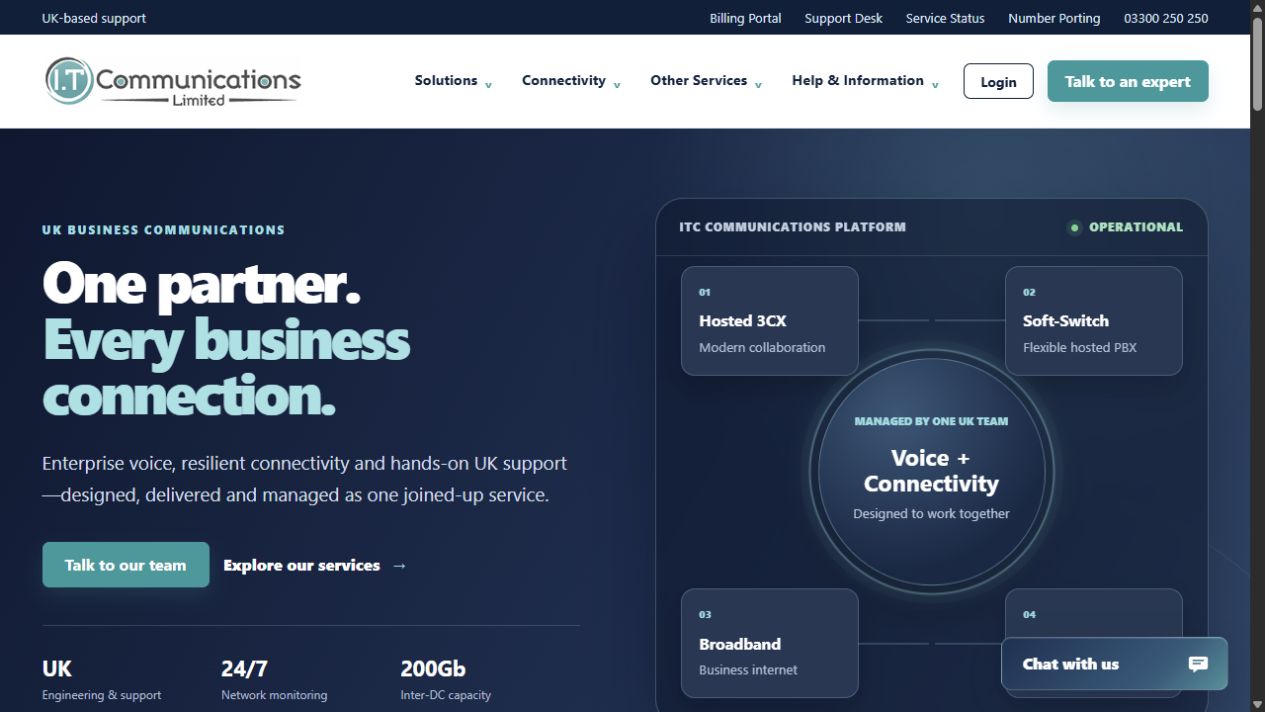
Structured navigation across business voice, 3CX, Soft-Switch PBX, connectivity, infrastructure and support.
A clear proposition built around one accountable UK partner, joined-up delivery and ongoing service ownership.
Focused routes into service information, live tariff data, number porting, reseller services and expert contact.
Responsive native pages with structured metadata, natural service-led content and clear internal linking.
The operational portal
The portal provides a central workspace for customer, service, commercial and operational activity. Rather than forcing telecom processes into a generic system, individual modules follow the data, decisions and actions required by the business.
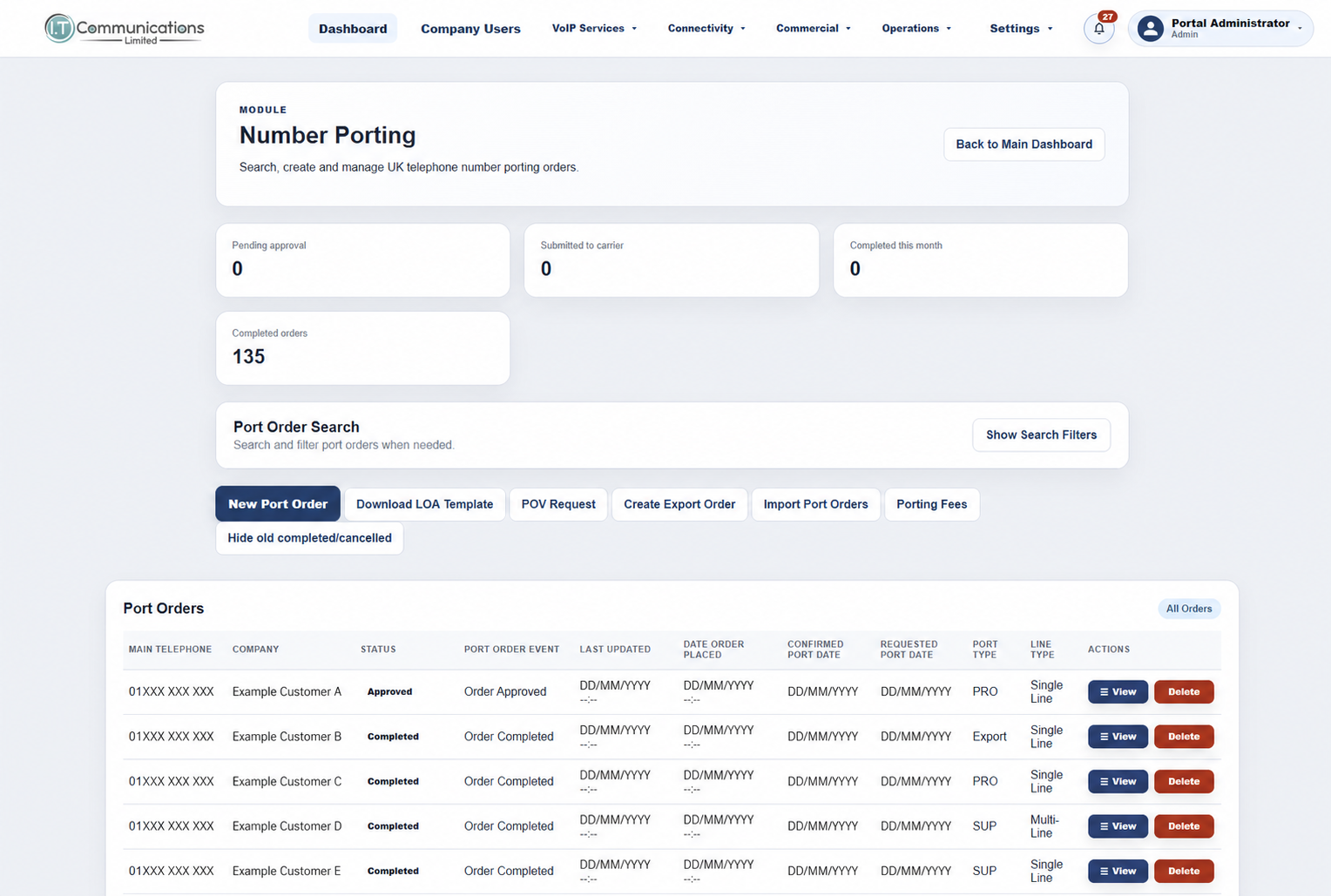
Create, import, export, search and progress UK number-porting orders through one structured module.
Keep company access, users and the appropriate operational context connected.
Bring telecom service administration into the same controlled working environment.
Support structured requests, approvals and status visibility across operational teams.
Connect LOA templates and supporting information to the workflow they belong to.
Summaries, filters and searchable records help teams understand workload and progress.
Connected automation
A bespoke portal can extend beyond administration to connect commercial and operational workflows. Service quoting, order capture and provisioning can be brought into one controlled journey, reducing the need to re-enter the same information across separate systems.
Where a carrier provides an appropriate API, number-porting submissions and status updates can also be connected directly into the carrier workflow. This creates the potential for a more automated end-to-end process while retaining the validation, exception handling and human oversight the operation requires.
Present agreed services and pricing through a structured quoting journey.
Turn an accepted quote into a trackable service order and provisioning workflow.
Submit supported porting data and receive relevant status updates electronically.
Reduce repetitive handling so teams can focus on winning business and looking after customers.
Carrier & supplier examples
We can assess the APIs available through your existing carrier and supplier relationships, then design the appropriate quoting, ordering, provisioning, porting and status workflows around them.
Potential workflows include number availability and allocation, routing, geographic or mobile port submissions, port status events and call-detail data.
Potential integrations include number search and management, number activation, porting submissions and port-order status.
Partner API and platform capabilities can support agreed service provisioning, number porting, reporting and service-management journeys.
Partner-facing API and portal services may be connected to supported connectivity provisioning and operational workflows.
Available APIs can support selected broadband, Ethernet and hosted-communications journeys including availability, validation, quotes, orders and status.
We can review documented APIs from other providers and define a secure integration where access, commercial permission and technical capability allow.
Supplier names are examples of platforms with published API or partner-integration capabilities. They do not imply endorsement, partnership or universal compatibility. Every integration requires discovery, suitable customer credentials, supplier approval where applicable, and confirmation of the current API scope. A connected workflow does not guarantee port acceptance or remove the need for operational review.
The connected value
The public website and secure portal serve different audiences, but they are designed around the same services, brand and operational reality.
The website turns a broad telecom portfolio into understandable customer journeys.
Clear calls to action direct customers and partners towards the appropriate next step.
The portal gives authorised teams structured tools to carry out the work behind the service.
Status, records and operational views create a stronger foundation for ongoing improvement.
The business story behind the platform
From manual telecom processes to connected digital workflows
As I.T Communications developed, a number of important telecom processes still depended heavily on staff administration, emails, individual requests and manual handling. These processes worked, and they had supported the business through earlier stages of its development. The issue was not that email or staff intervention had failed. The issue was that the experience no longer reflected how I.T Communications wanted customers and employees to work as the organisation continued to evolve.
A straightforward request could involve information moving between a customer, an inbox, a spreadsheet, a document and a member of the operations team. Each stage was manageable on its own, but the overall journey could require repeated communication and depend on somebody being available to retrieve information or carry out the next step.
The transformation therefore began with a practical question: which parts of these established processes genuinely required human knowledge, and which parts could be made clearer, faster and more consistent through a structured digital journey?
“The starting point wasn't the software. It was understanding how each process worked, where customers were waiting, where our team was repeating work, and then asking which parts could be made better through technology.”
Number porting
Number porting had traditionally involved significant manual administration and communication. A porting request contains specific information, supporting documents and a sequence of actions. When details are incomplete, the administration surrounding the port can expand into additional messages, checks and requests for clarification.
The portal changed the way this journey could be managed. Customers can submit porting orders through a controlled environment, provide the necessary information and supporting material, and follow the process in a much more organised setting. Staff receive a clearer record of the request and can manage it through the relevant operational stages.
This does not remove the carrier, eliminate exceptions or guarantee that a port will succeed. It improves the administrative workflow around the port: submissions are more structured, related information remains together, status is easier to understand and dependence on disconnected email conversations is reduced.
Telephone-number selection
Telephone-number selection provides a clear example of how a small customer request can create repeated administration. Previously, a customer depended on a member of staff to search for suitable available numbers, return the options, receive the customer's selection and then process the request.
The new digital environment allows customers to search available telephone numbers themselves, see the available options in real time and request selected numbers for activation against their account or services. Operational controls still apply, but the customer no longer has to wait for a member of staff to perform a routine lookup before making a choice.
Customer contacts I.T Communications
Staff search for numbers
Options returned
Customer chooses
Staff process request
Customer searches
Sees available numbers
Selects
Submits activation request
Call tariff information
Call pricing can cover destinations around the world, including international and specialist rates. Previously, a customer wanting an individual rate could need to contact I.T Communications and wait while somebody retrieved the relevant information.
The digital environment allows customers to access current configured call pricing directly. They can search for a destination and review the applicable rate without creating a routine enquiry for the service team. Centrally managed tariff information makes this possible: the business maintains control of the source data while the appropriate information is presented through the customer-facing journey.
The wider principle is important. Information that is safe and useful for customers to access should be available without an unnecessary administrative barrier, while its maintenance and governance remain under operational control.
Operational workflow
The transformation was also about the internal experience. When information arrives through structured portal journeys, staff can work from better organised records rather than reconstructing the position from separate messages, attachments and notes. The relevant customer, request, documents and status can remain connected.
This improves visibility without pretending that software makes every decision. Staff can see what has been supplied, understand which stage has been reached and identify where review or intervention is needed. Clearer records also make ownership easier to establish when work crosses customer-service, commercial or operational teams.
The result is a more controlled foundation for customer activity: predictable administration can be handled consistently, while exceptions and decisions continue to be managed by the people with the appropriate knowledge and authority.
Customer self-service
The objective was to remove unnecessary administrative barriers. Customers who want to perform straightforward tasks themselves should be able to do so immediately, while the I.T Communications team remains available whenever human assistance, judgement or telecom expertise is genuinely required.
Well-designed self-service does not make the relationship less personal. It prevents customers from having to wait for simple information and gives staff more opportunity to concentrate on the situations where their knowledge genuinely adds value.
Structured submissions keep relevant details and documents connected to the activity they support.
Searchable records and status views provide a more coherent picture than disconnected correspondence.
Authorised staff can understand customer activity, ownership and the next action more easily.
The public website helps customers discover services; the portal allows appropriate interactions to continue digitally.
Website and portal together
The public website and customer portal were deliberately developed as complementary parts of the digital experience rather than unrelated systems. The website helps customers discover and understand I.T Communications' services. When an interaction is suitable for self-service or a structured operational process, the portal allows that journey to continue digitally.
This reinforces the technical principle shown earlier on the page: one business can need two purpose-built experiences. The website attracts, explains and guides. The portal collects information, supports interactions and provides operational structure. Together they create a more coherent relationship between what the customer sees and how the business fulfils the request behind it.
The client's perspective
“Our objective was never simply to replace our website. We wanted to rethink how customers interact with I.T Communications and how our team manages the processes behind those interactions.
Led by our Lead Developer, Samantha Benwell, the project developed into a much broader transformation of our customer and operational environment. Processes that had traditionally involved significant manual administration could be reconsidered as structured digital workflows.
Number porting is an excellent example. Rather than relying so heavily on disconnected communication and manual handling, customers now have a structured environment through which their porting requirements can be submitted and managed.
Telephone-number selection has also changed significantly. Customers can search available numbers and make their selection digitally rather than depending on a member of staff to manually retrieve and send available options. Likewise, call tariff information can be made available directly to customers, giving them immediate access to current destination pricing.
These individual developments form part of a much bigger philosophy. We want customers to be able to access information and perform straightforward tasks when it suits them, while ensuring our team remains available whenever human knowledge, assistance or intervention is needed.
Automation was never about removing customer service. It was about removing unnecessary administration from customer service.
The resulting website and portal have created a much more connected digital environment around the way I.T Communications operates. Most importantly, the technology was designed around the business rather than forcing the business to change itself to accommodate generic software.
The experience demonstrated how much opportunity still exists within telecommunications to improve established operational processes through carefully designed software.”
The practical foundation for Telecom Software
Every telecom provider operates differently. Services, suppliers, permissions, teams, customer types and operational controls vary. Telecom Software does not simply sell a copy of the I.T Communications portal.
The lesson from I.T Communications was that significant operational improvements can be achieved when software is designed around the company's actual processes. This is the philosophy Telecom Software now brings to carriers, resellers, wholesalers, VoIP providers, ISPs and MSPs.
We don't start by asking which software package you want. We start by asking how your business works today.Show us the spreadsheets. Show us the inboxes. Show us the repetitive tasks. Show us where customers have to wait. That's where the conversation starts.
What this demonstrates
This work shows the difference between producing an isolated website and creating a useful telecom platform. Customer-facing design, operational software and industry knowledge inform one another.
Pages and portal modules reflect actual telecom services and workflows.
Public and secure environments feel like parts of the same established provider.
Purpose-built workflows replace disconnected documents and repeated manual handling where appropriate.
A modular foundation allows further services, carrier connections and workflows to be introduced as requirements develop.
Screenshots show genuine completed work. Portal customer and user data has been replaced for privacy. Feature availability and integrations are specific to I.T Communications; every customer platform is scoped around its own services, permissions, processes and supported systems.
Show us the spreadsheets, inboxes and repetitive tasks. We’ll explore how the process could work tomorrow.